


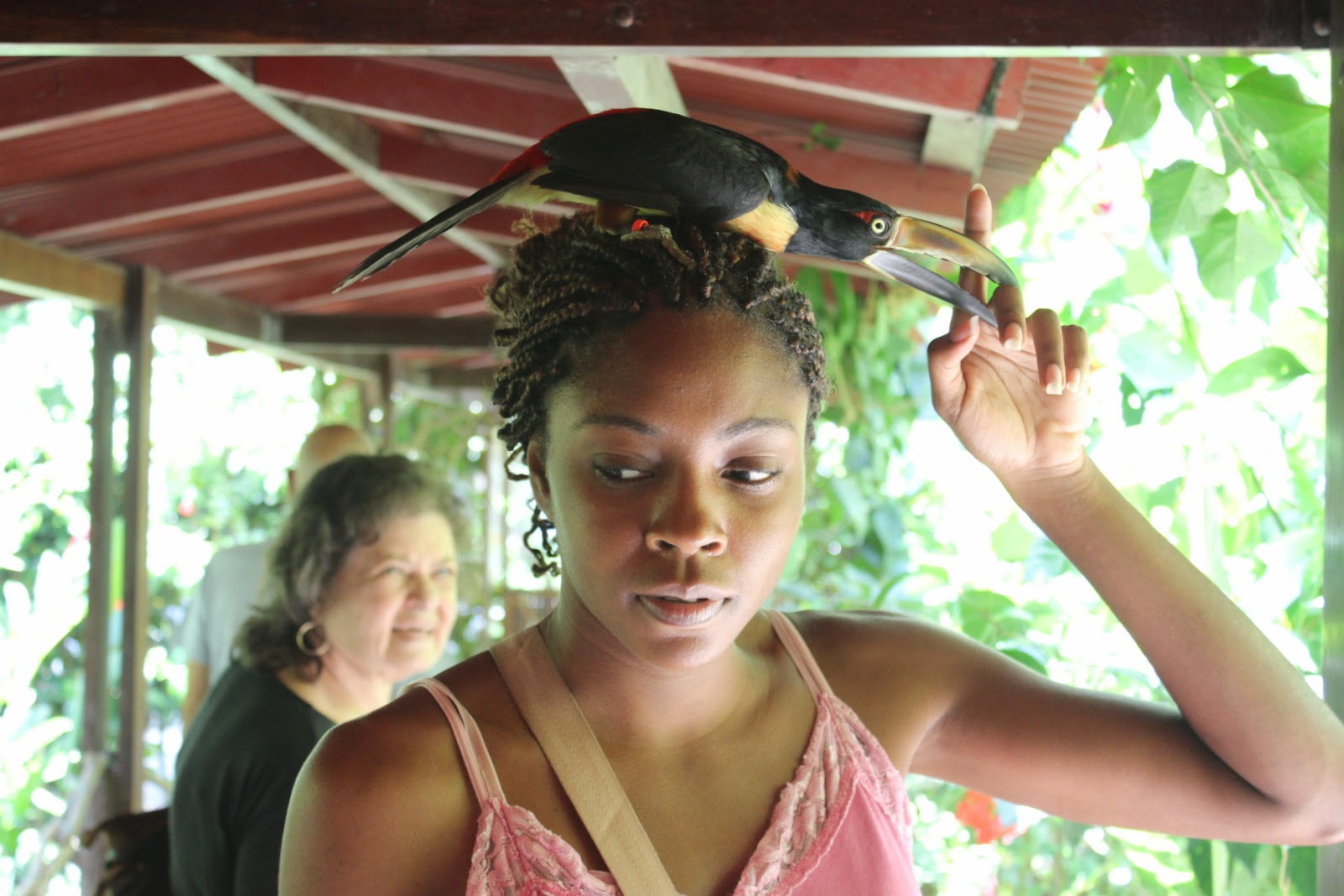


Before Zander and I got burned on the beaches of Puerto Viejo, we got a little pink walking through the Jaguar Rescue Center.
Two European biologists came to Costa Rica's less-touched Caribbean coast to claim a slide of paradise for themselves after visiting multiple times. Their new found quiet, relaxing lifestyle was short lived; it wasn't long before local farmers, fishers, and people learned of their former careers and began bringing them sick and injured animals. The couple found they couldn't say no to lending a helping hand, and it wasn't long before they founded the Jaguar Rescue Center (JRC) in Puerto Viejo.
The first and foremost goal of the Rescue Center was to nurse sick and injured animals back to health until they could be released back into the wild. But these expats saw a greater need to educate the locals on handling native wildlife - dispelling folklore that often led people to kill endangered animals, and providing a framework for understanding the Costa Rican jungles as habitats for these important creatures.
I was nervous to visit the JRC when I first read about it. I cynically suspected it was more of a petting zoo than a rehabilitation center, and I was wrong. I wholeheartedly agree with and support the JRC's mission. It was evident the second Zander and I stepped into the open-air Center that their priorities are the animals and educating the public. We learned so much while we were there. I would be writing forever if I shared everything, but here are just a few of the highlights of our incredible visit.
We saw and learned about 3 different species of Toucans - each one more colorful than the next. They hopped on branches and awnings of the building all around us, curiously gazing and cocking their long beaks but never venturing closer.
A true highlight of this trip (and of my life!) was getting to interact with baby howler monkeys. These little fellas lost their mothers early on and are dependent on affection and hands-on-care to reproduce the natural socializing aspects they would encounter in the wild. To mimic that interaction, humans do play with them, and we got the opportunity to tickle, pet, and feed them -- if they wanted to come up to us. Monkeys are such social creatures! None of them jumped on our shoulders or came close enough to cuddle, but they curiously eyed up and creeped up close enough for us to pet.
We spent a while talking about snakes and seeing a variety of the ones native to the area. Costa Rica has two types of venomous snakes - corals and vipers. But there are 139 species of snakes total in the country. There are about 600 snake bites each year - a low number when you think of the sheer number of snake there are. A huge number when you think of hiking through the jungle.
Learning more about snakes actually, shockingly (or not so shockingly?) helped make me less fearful of them. Sort of. I mean, I'm still me and paranoid about those terrifying things. Our guide stressed that almost all snakes are defensive and will move when they feel the vibrations of anything larger than it could eat coming near. We saw a boa constrictor (shudder), a viper, and a coral snake.
The Center has multiple owls, two of which - a male and a female - are 'residents,' meaning they are too injured to return to the wild and will spend their lives in the Center. Owls mate for life, our guide noted, and the Center is hoping that these two will mate and have babies that can be released into the wild. Apparently, they've been sitting closer together in recent months. The owl love story was a 'hoot.' (Groan!)
The anteaters and sloths were adorable, as expected. They're in the same family, which I did not know. The sloths were sleeping, but the anteaters were licking ants out of a cup held by a volunteer - using their super sticky tongues to slurp them up.
The Center didn't have any jaguars when we visited, but they were taking care of a young Margay. They're the smallest of Costa Rica's four wild cats. The Center also has an old Osolot who is a resident. Our guide emphasized that not even the volunteers interact with the cats; these animals are not meant to socialize or become accustomed to humans, so they stay away. Volunteers do clean the cages, buy they do it from a distance, never nearing the animals.
Our guide was an expat from Holland. She was beautiful - a very long torso (is that a weird thing to notice/comment on?). Everyone there is a volunteer. She was knowledgable and passionate about her work there, even though it's unpaid.
I've found that I'm drawn to volunteer-led animal rehabilitation and rescue centers when I travel. I fell in love with the Moholoholo Rehabilitation Center outside of Kruger National Park in South Africa. I wanted to move to Thailand to do long-term volunteer work at the Elephant Nature Reserve in Chiang Mai. And I would certainly relish the opportunity to practice my Spanish while protecting Costa Rica's native wildlife at the Jaguar Rescue Center.


